loading...


Quantum machine learning (QML) is an emerging field that combines quantum computing principles with classical machine learning algorithms. Researchers are exploring the potential of using quantum computers to solve complex machine learning problems more efficiently and accurately. QML algorithms offer the promise of unparalleled computational capabilities, but their full potential relies on the development of efficient and scalable quantum hardware. As the field of quantum computing continues to advance, efforts are being made to design and build quantum systems that can handle the computational demands of QML, paving the way for transformative advancements in machine learning.
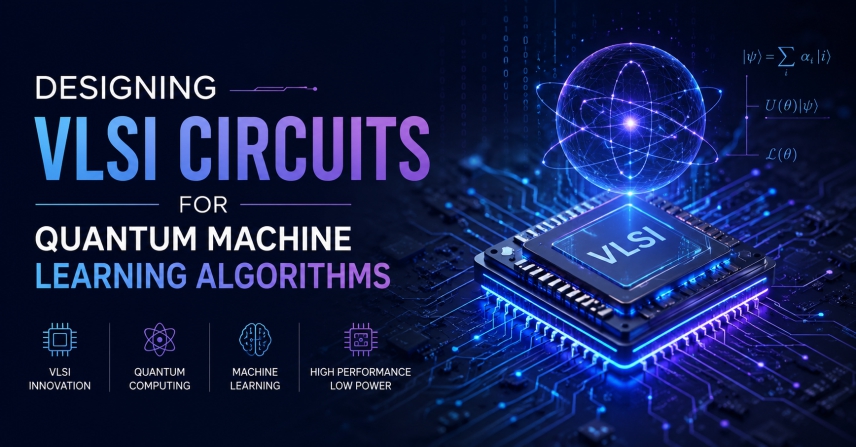
Despite the challenges, researchers from top VLSI training institutes are optimistic about the potential of QML. As quantum computing technology continues to advance, QML algorithms hold the promise of revolutionizing fields like optimization, data analysis, cryptography, and artificial intelligence, unzipping unprecedented computational capabilities. As the field progresses, QML is likely to play a pivotal role in solving some of the most intricate and data-intensive machine learning problems.
Quantum Machine Learning (QML) is a rapidly evolving interdisciplinary field that aims to harness the power of quantum computing to enhance classical machine learning algorithms significantly. Quantum computers leverage the principles of quantum mechanics, such as superposition and entanglement, to perform certain computations exponentially faster than classical computers. This enables the development of novel algorithms that can solve complex machine learning problems with unprecedented efficiency.
One of the key advantages of QML algorithms is their ability to exploit quantum parallelism. While classical computers process data sequentially, quantum computers can process multiple possibilities simultaneously through superposition. This allows QML algorithms to analyze and process a vast number of data points concurrently, making them particularly well-suited for tasks involving large datasets.
Quantum support vector machines (QSVM) are one of the prominent QML algorithms. They are used for classification tasks and are designed to find an optimal hyperplane that separates different classes of data points. QSVM can outperform classical support vector machines when dealing with high-dimensional data due to the quantum parallelism and other quantum properties.
Quantum Error Correction: Quantum computers are highly susceptible to errors due to environmental noise and decoherence. Quantum error correction techniques are employed to mitigate these errors and enhance the reliability of quantum computations. However, implementing error correction in VLSI circuits poses significant challenges due to the additional overhead and increased complexity.
Scalability: Quantum machine learning algorithms often require a large number of qubits and gates to be effective. Designing VLSI circuits capable of handling this scale is a formidable task. The challenge lies in maintaining coherence, minimizing crosstalk, and managing power consumption while scaling up the quantum processor.
Quantum Circuit Synthesis: Transforming high-level quantum algorithms into physical circuits involves the process of quantum circuit synthesis. This involves mapping logical qubits to physical qubits on the chip while optimizing for circuit depth and gate count. Achieving efficient quantum circuit synthesis is vital to ensure that quantum machine learning algorithms can be effectively implemented on VLSI chips.
Hybrid Quantum-Classical Approach: To overcome the challenges of error correction and scalability, researchers are exploring hybrid quantum-classical approaches. These techniques leverage the strengths of both quantum and classical computing to perform complex computations with greater efficiency and reduced error rates.
Quantum Compilation: Quantum compilation is a key area of research that focuses on converting high-level quantum algorithms into optimized quantum circuits. By developing better compilation strategies, the overall efficiency and performance of VLSI circuits for quantum machine learning can be significantly improved.
Novel Quantum Architectures: Researchers are investigating novel quantum computing architectures, such as topological qubits and trapped ions, which exhibit greater stability and resilience to errors. Implementing these architectures in VLSI circuits can lead to more robust and reliable quantum processors.
Quantum Error Mitigation Techniques: Besides error correction, various error mitigation techniques are being explored to improve the performance of quantum algorithms. These techniques, when integrated into VLSI circuit design, can enhance the accuracy of quantum machine learning algorithms without the need for additional qubits or gates.
Quantum Compilation Libraries: The development of specialized quantum compilation libraries can simplify the task of mapping high-level quantum algorithms to VLSI circuits. These libraries can automate the optimization process and provide standardized solutions for various quantum machine learning tasks.
Conclusion
The intersection of quantum computing and machine learning holds immense promise for solving computationally intensive problems. Designing VLSI circuits for quantum machine learning algorithms is a critical step towards realizing this potential. Overcoming the challenges of error correction, scalability, and quantum circuit synthesis will pave the way for practical and efficient quantum machine learning implementations on VLSI chips. As advancements continue, we can anticipate the emergence of powerful quantum processors that revolutionize the landscape of artificial intelligence and computational capabilities. Through collaboration between quantum physicists, computer scientists, and chip designers, we are witnessing the dawn of a new era in quantum machine learning on VLSI circuits.
For advanced VLSI training with placement, contact FutureWiz and upscale your career.
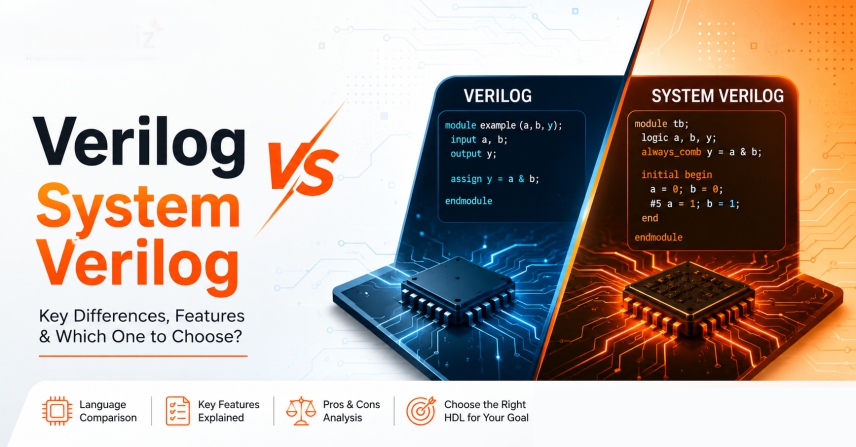 Verilog vs SystemVerilog - A Complete Guide for VLSI Learners
 How to Build a Killer VLSI Portfolio in College (5 Projects Every Student Should Do)
 RTL Design Best Practices That 90% of Freshers Ignore (But Companies Love)
 Digital VLSI vs Analog VLSI vs Mixed-Signal – Which One Should You Choose in 2026?
 Designing VLSI Circuits for Quantum Machine Learning Algorithms
 Online vs. Traditional VLSI Physical Design Courses: Pros and Cons
 Advances in VLSI Design for Artificial Intelligence Applications
 Choosing the Right VLSI Training Institute: Factors to Consider
 VLSI Design for Energy-Efficient Wireless Sensor Networks
 How to Become a VLSI Chip Designer: A Beginner's Roadmap for 2026
 A to Z on India, Japan & the Future of Semiconductor Industry: A New Chapter in Tech Collaboration
 RTL Design vs Physical Design: What's the Real Difference?
 The Future of the Semiconductor Industry: What Indian Students Should Know
 Top 7 Career Paths After Completing a VLSI Course
 Best Time Management Tips for Students Preparing for VLSI Careers
 Mastering VLSI Physical Design: A Comprehensive Course Overview
 The Complete FPGA and ASIC Guide
 Verilog Essentials: Mastering the Fundamentals of Hardware Description Language
 Unleashing the Power of System Verilog: A Comprehensive Guide for Aspiring Designers
 Demystifying VLSI chip Design: Exploring the Core Concepts of VLSI Courses
 Basics of VLSI - An Ultimate Guide
 Career Prospects After Completing A VLSI Course
 Top 5 Reasons To Take Up A Professional VLSI Course
 Mastering VLSI Design: A Comprehensive Guide To Understanding Complex Integrated Circuits
 Future-Proof Your Career With A VLSI Course: How Learning About Integrated Circuits Can Boost Your Job Prospects?
 System Verilog: An Overview
 Introduction to Hardware Description Language (HDL)
 Unlock The Potential Of VLSI Design With An Integrated VLSI Course Online
 Universal Verification Methodology:An Efficient Verification Approach
 How to Write a Verilog Module for Design and Testbench
 What Are the Different Career Paths in the VLSI Industry?