loading...



Verilog is a Hardware Description Language (HDL) introduced in the 1980s and standardized as IEEE 1364. It was created primarily to describe and simulate digital hardware at the Register Transfer Level (RTL) and gate level. Engineers use Verilog to model how digital circuits like adders, multiplexers, counters, and processors behave and how signals flow between them.
Verilog is great for describing hardware structure and behavior, but it was never designed with heavy-duty verification in mind. As chip complexity grew exponentially, engineers found Verilog's testbench capabilities too limited for modern verification needs, leading to the birth of SystemVerilog.
SystemVerilog, standardized as IEEE 1800, is a superset of Verilog. This means every valid Verilog construct is also valid in SystemVerilog, but SystemVerilog adds a massive set of new features on top, targeting two areas: enhanced RTL design and advanced verification. It merges the world of hardware description with object-oriented programming concepts, giving verification engineers the tools to build sophisticated, reusable testbenches.
1. Data Types
Verilog primarily uses reg and wire to represent signals. These types have limitations; for instance, "reg" doesn't strictly mean a hardware register, which often confuses beginners. SystemVerilog introduces the logic type, which can be used almost anywhere reg or wire was used, removing ambiguity. It also adds bit, byte, int, shortint, longint, and string types for more precise and efficient coding.
// Verilog
reg a, b, y;
wire c;
// SystemVerilog
logic a, b, y;
bit [7:0] data;
string msg = "Hello VLSI";
2. Procedural Blocks
In Verilog, all sequential and combinational logic is written using a generic always block, and it's up to the designer to ensure correct sensitivity lists.
In Verilog, always blocks depend on the signals listed in the sensitivity list.
SystemVerilog goes one step further with always_comb, which automatically determines the sensitivity and also provides additional checks.
// Verilog
always @(a or b)
y = a & b;
always @(posedge clk)
q <= d;
SystemVerilog splits this into three specialized blocks, always_comb, always_ff, and always_latch, making the designer's intent explicit and helping tools catch coding mistakes early.
// SystemVerilog
always_comb
y = a & b;
always_ff @(posedge clk)
q <= d;
3. Interfaces
In large designs, connecting modules with dozens of signals through individual ports becomes messy in Verilog. SystemVerilog introduces the interface construct, which bundles related signals into a single reusable unit, dramatically simplifying module connections.
interface bus_if;
logic clk, valid, ready;
logic [31:0] data;
endinterface
4. Object-Oriented Programming (OOP) for Verification
This is the biggest leap. Verilog has no support for classes, inheritance, or polymorphism. SystemVerilog introduces full OOP capabilities, enabling engineers to build structured, reusable verification environments (like UVM Universal Verification Methodology).
class Packet;
rand bit [7:0] addr;
rand bit [7:0] data;
function void display();
$display("Addr=%0d Data=%0d", addr, data);
endfunction
endclass
5. Constrained Random Verification
Verilog testbenches typically use directed tests with manually written stimulus for each scenario. This doesn't scale for verifying today's complex SoCs. SystemVerilog supports constrained random stimulus generation, allowing engineers to define valid ranges and let the simulator generate thousands of legal random test cases automatically.
class Transaction;
rand bit [3:0] addr;
constraint addr_range { addr inside {[0:10]}; }
endclass
6. Assertions (SVA)
Verilog has no built-in way to formally check design behavior over time. SystemVerilog Assertions (SVA) let engineers describe expected temporal behavior directly in code, catching bugs early during simulation.
property req_ack;
@(posedge clk) req |-> ##[1:3] ack;
endproperty
assert property (req_ack)
else $error("Ack not received in time!");
7. Functional Coverage
Verilog does not provide native functional coverage constructs such as covergroup, coverpoint, and cross, which help us to determine how much of the functionality is verified.
SystemVerilog introduces these constructs to measure whether the intended functional scenarios have been exercised.
covergroup cg;
coverpoint addr;
endgroup

| Aspect | Verilog | SystemVerilog |
| Primary use | RTL Design | Design + Verification |
| Data types | reg, wire | logic, bit, string, and more |
| OOP support | No | Yes (classes, inheritance) |
| Random stimulus | Manual / directed | Constrained-random |
| Assertions | Not supported | SVA supported |
| Interfaces | No | Yes |
| Coverage | Not supported | Functional coverage |
If you're aiming for an RTL design role, you'll spend most of your time with Verilog-style coding, though SystemVerilog's improved data types (logic, always_comb, always_ff) are increasingly the industry standard even for design. If you're targeting a verification role (a fast-growing and high-paying field), SystemVerilog is non-negotiable; it's the foundation of UVM, the industry-standard verification methodology used at nearly every semiconductor company.
Key Takeaway
In short: Verilog builds the hardware description foundation, while SystemVerilog builds on top of it to enable both smarter design coding and powerful, scalable verification.
Think of Verilog as the base language of digital design and SystemVerilog as its supercharged evolution, bringing modern software engineering concepts into the world of chip verification.
At FutureWiz, our RTL Design and Verification courses cover both languages hands-on, from writing your first always block to building full UVM testbenches with constrained-random stimulus and coverage-driven verification. Whether you're aiming for a design or verification career in the semiconductor industry, mastering this distinction is your first real step forward.
Ready to go from Verilog basics to SystemVerilog-powered verification? Join FutureWiz and build your chip design career the right way.
 Verilog vs SystemVerilog - A Complete Guide for VLSI Learners
 How to Build a Killer VLSI Portfolio in College (5 Projects Every Student Should Do)
 RTL Design Best Practices That 90% of Freshers Ignore (But Companies Love)
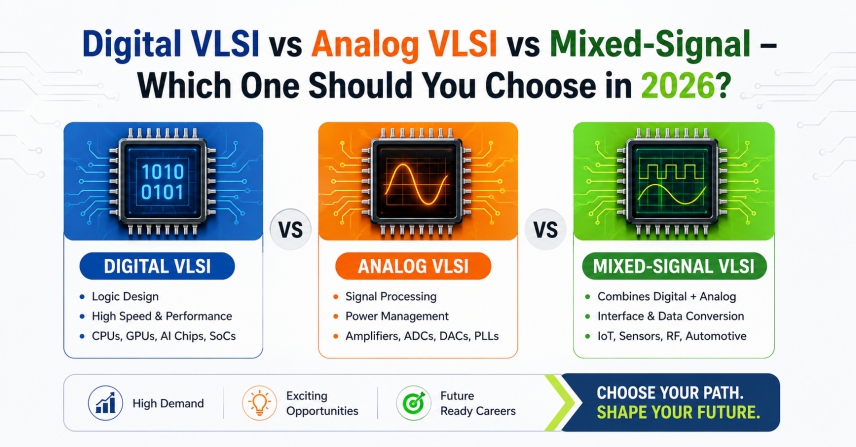 Digital VLSI vs Analog VLSI vs Mixed-Signal – Which One Should You Choose in 2026?
 Designing VLSI Circuits for Quantum Machine Learning Algorithms
 Online vs. Traditional VLSI Physical Design Courses: Pros and Cons
 Advances in VLSI Design for Artificial Intelligence Applications
 Choosing the Right VLSI Training Institute: Factors to Consider
 VLSI Design for Energy-Efficient Wireless Sensor Networks
 How to Become a VLSI Chip Designer: A Beginner's Roadmap for 2026
 A to Z on India, Japan & the Future of Semiconductor Industry: A New Chapter in Tech Collaboration
 RTL Design vs Physical Design: What's the Real Difference?
 The Future of the Semiconductor Industry: What Indian Students Should Know
 Top 7 Career Paths After Completing a VLSI Course
 Best Time Management Tips for Students Preparing for VLSI Careers
 Mastering VLSI Physical Design: A Comprehensive Course Overview
 The Complete FPGA and ASIC Guide
 Verilog Essentials: Mastering the Fundamentals of Hardware Description Language
 Unleashing the Power of System Verilog: A Comprehensive Guide for Aspiring Designers
 Demystifying VLSI chip Design: Exploring the Core Concepts of VLSI Courses
 Basics of VLSI - An Ultimate Guide
 Career Prospects After Completing A VLSI Course
 Top 5 Reasons To Take Up A Professional VLSI Course
 Mastering VLSI Design: A Comprehensive Guide To Understanding Complex Integrated Circuits
 Future-Proof Your Career With A VLSI Course: How Learning About Integrated Circuits Can Boost Your Job Prospects?
 System Verilog: An Overview
 Introduction to Hardware Description Language (HDL)
 Unlock The Potential Of VLSI Design With An Integrated VLSI Course Online
 Universal Verification Methodology:An Efficient Verification Approach
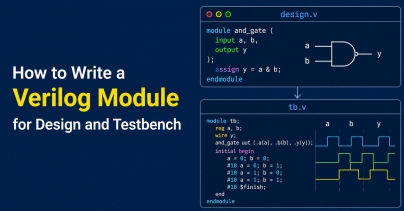 How to Write a Verilog Module for Design and Testbench
 What Are the Different Career Paths in the VLSI Industry?